The Efficient Frontier of Teaming™: A New Way to Understand Team Performance
Why Teams Struggle to Sustain Performance
Diagnosing where your team is operating today
Most teams do not fall short because of a lack of talent or effort. They struggle because the way they work together creates hidden friction. Decisions slow down. Meetings feel busy but inconclusive. Follow through depends on a few people carrying too much of the load. These challenges are frustrating precisely because the team appears capable on paper.
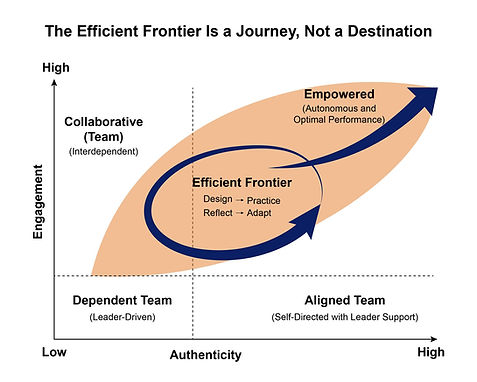
The Efficient Frontier of Teaming™ introduces The Four Levels of Team Development™ to help leaders make sense of this disconnect. Teams typically operate as Dependent, Collaborative, Aligned, or Empowered. Each level reflects a different degree of trust, clarity, and shared ownership. Performance problems often emerge not because teams are broken, but because leaders are expecting outcomes their current level of development cannot yet support.
This framework allows leaders to diagnose their team’s current operating level without judgment and focus on the specific shifts required to move forward. Instead of applying generic fixes, leaders can target the conditions that unlock the next level of performance.
A Different Way to Think About Team Performance
Closing the Teaming Inefficiency Gap™
Traditional performance efforts focus on outcomes while ignoring the cost of achieving them.
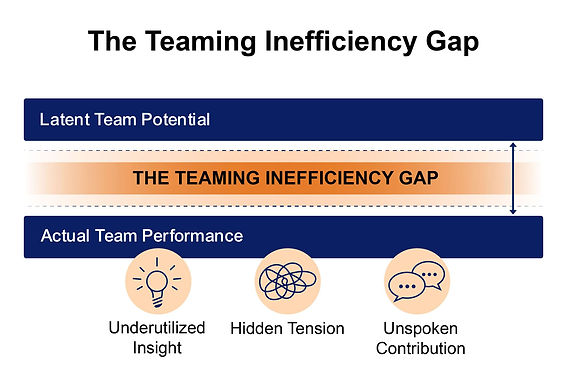
The Efficient Frontier of Teaming™ reframes performance as the relationship between results and the energy required to produce them. The space between what a team is achieving and what it is capable of achieving is defined as the Teaming Inefficiency Gap™.
This gap shows up in everyday interactions: guarded communication, unclear decision rights, hesitation to challenge assumptions, and uneven ownership. When engagement and authenticity are constrained, teams compensate by working harder rather than working better. Effort increases, but performance remains fragile under pressure.
By identifying and reducing inefficiency in how teams communicate, decide, and execute, leaders can close this gap. The result is stronger performance delivered with greater consistency and less strain on both leaders and team members.
What You Will Walk Away With
A practical operating model for sustained performance
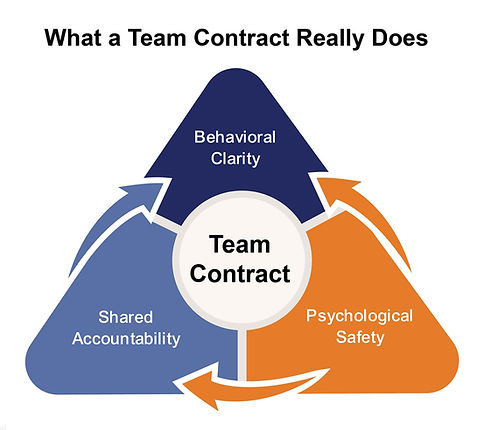
Rather than offering a collection of disconnected tools, The Efficient Frontier of Teaming™ gives readers a single, integrated way to design how their team works together. At the center of this approach is the Team Contract™, a practical framework for making expectations explicit around communication, decision making, and shared accountability.
The Team Contract™ helps teams move from assumptions to clarity. It creates alignment around how work gets done, how decisions are made, and how responsibility is shared, especially when pressure is high. This clarity supports engagement and authenticity by reducing ambiguity and making it safer for people to speak up and take ownership.
Readers finish the book with a repeatable operating model they can revisit as the team evolves. Instead of relying on motivation or individual effort, leaders gain a clear structure for sustaining performance through intentional design.